Procurement note
What Genie GRC-12 Aerial Work Platform Guardrails Protect — and Don't
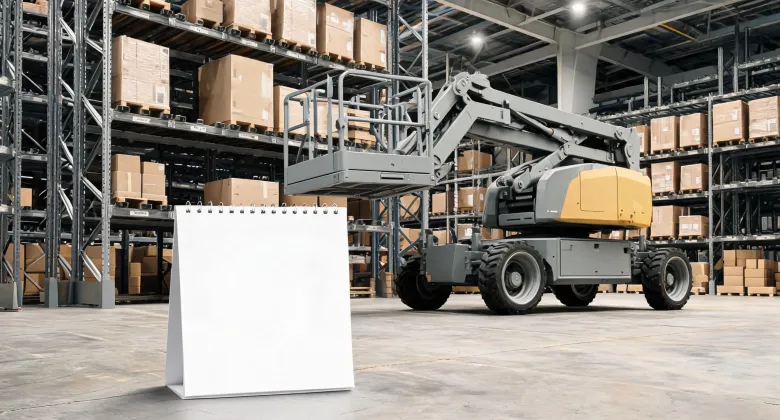
Picture two operators working the same rack bay from the same Genie GRC-12, an hour apart. One has swept the platform floor, closed the entry gate, and stands with both feet flat while reaching into the level being picked. The other has the gate swung open, a wrap of shrink film rolling underfoot, and one hip parked on the top rail while stretching for a case. Same machine, same height, same task. One is inside a fall-protection system; the other is standing next to one.
In the Genie GRC-12 operator manual for the US ANSI/CSA market, manual 133573, second edition, fall protection is assigned to the guard rail system itself. Personal fall protection equipment shows up later, and only conditionally, tied to job site or employer rules rather than to the rail's presence. That makes the harness question a policy question and the rail question an engineering one, the one worth getting straight.
Two Shifts, One Open Entry Gate
Read a few pages apart in the same manual, the two statements look unrelated: the rail system provides fall protection, and the entry gate must be closed before operating. They describe one system from two angles, because a barrier only counts as a barrier while it is closed.
The gate sits at the single point on the platform where an operator's body is aimed every time they get in or out, so it is also where a barrier is most likely to be missing. An open gate does not weaken the rail sections around it; it deletes protection at the exact spot where movement is routine. Hence the phrasing as a step to complete before operation rather than a caution to remember during it.
The Parts the Manual Counts as Protection
Four pieces appear in the same stretch of text, each answering a different failure. One is the rail system, the fall protection itself. The entry gate closes the gap in it. Underfoot, the platform floor is what the operator stands on, and debris turns a flat standing surface into an uneven one. Last is the approved lanyard attachment point, which exists for the day an outside rule makes a harness necessary, so the lanyard has somewhere legitimate to land.
An attachment point being provided is not the same as it being required; its presence says the manufacturer expected some sites to run stricter rules than the manual does. Note what the rail is never described as: a step, a seat or a climbing frame. One component cannot be both the barrier and the way over it.
Why a Rail Works Before a Fall Starts
A person falls when their center of mass passes beyond the edge of what supports them and nothing intervenes before momentum builds. A guardrail intervenes at the earliest point in that sequence, while the mass is still over the platform floor and the speed is close to zero. Because the barrier acts at the start of the event rather than the end, it can be passive: nothing to activate, nothing to attach, nothing to inspect for deployment.
A fall arrest system looks so different, a harness and a lanyard and an anchor, because it works the second half of that sequence, after the mass has already left the platform. Arresting a fall means absorbing energy. Containing an operator means holding geometry. Only the second problem yields to a rail with no moving parts.
Which means the rail's real performance measure is not on the rail. Standing with both feet flat keeps the mass low and inside the barrier. Sitting on the top rail, standing on a mid-rail or climbing the rails moves that mass above the barrier that was meant to sit above the operator, and the rail becomes a lever rather than a wall. It comes down to posture and footing, because containment is a relationship between a body and a boundary.
When Site Rules Add a Harness on Top
Personal fall protection equipment enters the manual conditionally, and the condition is narrow: job site or employer rules. Not the machine, not the rail height, not the task. When such a rule applies, the equipment and its use follow the PFPE manufacturer's instructions and applicable governmental requirements, and the lanyard goes to the approved attachment point provided on the platform.
Suppose a warehouse writes its own rule that any work above a set height requires a harness. That policy switches the manual's conditional clause on for a machine whose rail already does the containing. Nothing about the machine changed; the site added a layer over it. Both misreadings cost money. A buyer who reads the manual as requiring PFPE everywhere stocks and inspects gear the machine never asked for, and a buyer who reads it as never requiring PFPE is caught by the first audit run to a stricter site rule.
Guardrail vs. Harness vs. Ladder in the Platform
All three items do different jobs, and blurring them is where crew rules go wrong. The rail contains, keeping the operator inside the platform volume. PFPE catches, and only when a rule switches it on, which is why it belongs on a designated attachment point rather than a convenient one. A ladder or scaffold placed in the platform, or against any part of the machine, is prohibited outright.
That prohibition follows the same geometry. A ladder raises the operator above the top of the barrier doing the protecting; one rung up and the rail that was at chest height is at knee height, and containment is gone. Tools and materials are allowed only when evenly distributed and safely handled by the people in the platform, for a related reason: a shifting load changes the machine's balance and gives loose objects a path to the edge.
Why the GRC-12 Manual Bounds This Answer
Every piece of wording above belongs to one document: Genie GRC-12, US ANSI/CSA, operator manual 133573, second edition, second printing May 2014, covering the serial ranges its applicability index lists for that edition. It does not carry to other models, and it does not carry into the later GRCP-6000 edition, which is a separate manual. Manual text is written per model, region and edition because the machine underneath it changes.
For procurement that becomes four questions: what serial is on the nameplate, which manual edition is in the document holder, whether the model and region on the cover match the unit, and whether that edition is still current for that serial. Ask for the manual itself rather than a summary, since both key sentences are short and easy to paraphrase into something less precise.
What the Rail Buys You and What It Costs
Treating the rail as primary protection buys something real: the operator wears nothing, clips nothing, runs no connection step, so protection is already working the moment they step in and pull the gate shut. What you give up is that its validity rests on three habits no hardware enforces: gate closed, floor clear, nobody using the rail as a seat or a step. An unclipped harness shows up on a spot check; an open gate is a two-second lapse that looks like nothing.
If I were writing the crew rule for a GRC-12, I would spend the training hour on the gate and the top rail rather than on the harness, and I would write any harness requirement as its own line labeled a site rule instead of a machine requirement. That stance holds only while those three habits hold, and it never overrides a job site or employer rule that requires PFPE: a stricter site policy stacks on top of the rail without changing anything about the machine.
Share this note with the buying team after you copy the units into your own brief.