Procurement note
Aerial Work Platform on a Slope: What the GRC-12 Manual Says
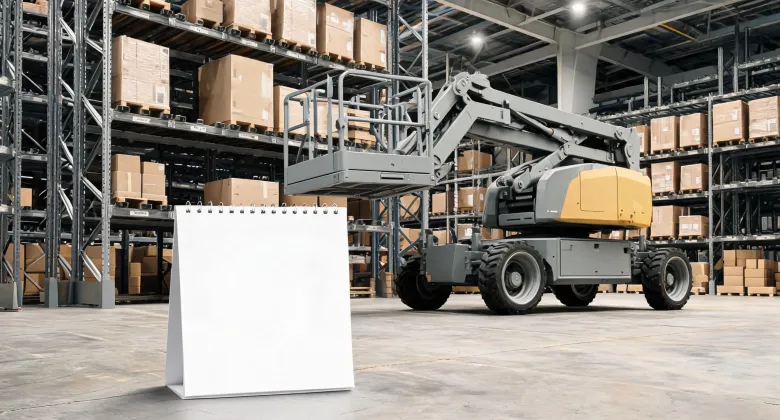
Can an aerial work platform be raised safely on a slope? On the Genie GRC-12 US ANSI/CSA, the answer is no. The operator manual says not to raise the platform unless the machine is on a firm, level surface, and that instruction belongs to the model, region, edition and serial range named here, not to every aerial work platform on the market.
The confusion is easy to understand. The same manual publishes a 30% (17°) slope rating, and a reader can easily read that number as permission to set up on a ramp. It is not. The rating is tied to the stowed position, which means it answers a travel question, while raising the platform is a different question with a different rule. What follows separates the two, explains why the machine behaves differently once the platform is up, and names the conditions that would cancel the rating altogether.
Can You Raise the Platform on a Slope?
The governing sentence is short and direct: “Do not raise the platform unless the machine is on a firm, level surface.” That is from Genie operator manual 133573, Second Edition/Second Printing May 2014, covering the GRC-12 in the US ANSI/CSA configuration. For this edition the matching serial ranges are GRC11-1000–GRC16-2369, GRC16P-2370–GRC16P-4599 and GRCP-4600–GRCP-5999. A unit outside those ranges, or a later manual edition, needs its own documentation before anyone borrows this answer.
Read the sentence as a condition on the work position, not on the route. A machine can be driven, stowed, across a surface that is not perfectly level; that is what a slope rating is for. Once the platform leaves the stowed position, the manual's requirement changes to firm and level. A slope that the machine may cross is therefore not automatically a slope that it may be raised on. The two states are separate in the document, and they should stay separate in a purchase or rental decision.
The scope matters because the sentence is not a category-wide rule. It is the named model's instruction, in a named region and edition, and it should not be pasted onto another brand, another model or a later serial range. If the unit on the floor has a different nameplate or a different manual edition, the first task is to find that unit's own instruction, not to assume that the GRC-12 wording carries over.
What the 30% Slope Rating Actually Covers
The published data set for this model is compact. The manual gives a maximum slope rating in the stowed position of 30% (17°) and a maximum side slope rating in the stowed position of 30% (17°). It also says that slope rating applies to machines in the stowed position, and it warns against driving on a slope that exceeds the slope and side slope rating. That is the whole data set relevant to this question.
What the data says is narrower than the number looks. It describes a travel limit for a stowed machine. It does not say that the machine may be raised on a 30% slope, and it does not set a separate elevated-work slope limit. The reason is structural: the rating is explicitly tied to the stowed position, so using it as an elevated-work rating would be using the number outside the state it describes.
The notation is also worth reading carefully. Grade percent is rise over run, while degrees measure the angle itself; the manual publishes both because they are two ways to express the same limit, not two different capabilities. A 30% grade and a 17° angle are the manual's matched notation for one rating. Neither notation changes when the platform is raised, because neither notation is an elevated-work rating in the first place.
What the data does not say is just as important. It does not say that a slope below the rating is a safe work position, and it does not say that adequate traction is guaranteed by the grade alone. The manual adds that slope rating is subject to ground conditions and adequate traction. That caveat is not a footnote to ignore; it is part of the rating's applicability.
For a buyer, the practical reading is simple. The 30% (17°) figure belongs in the travel column, not the elevated-work column. If a specification sheet or a sales conversation moves it into the elevated-work column, the number has been promoted beyond its source.
Why Lifting Changes Stability, Not Just Height
Why does raising the platform change the answer on the very same slope? The reason is geometry. Raising the platform moves the platform, the load and the operator upward, which means the center of gravity of the machine-plus-load system rises. The machine has not become wider or heavier at the base; it has become taller.
Stability comes down to a balance of moments. The overturning moment is the product of the load and the horizontal distance from the tipping line. When the machine tilts, that horizontal distance grows with height, which means the same tilt produces a larger overturning moment once the platform is raised. The restoring moment comes from the machine's weight acting through its base dimensions, and those base dimensions do not grow when the platform goes up.
That mismatch is the whole point. A stowed machine can have a comfortable margin on a slope because its center of gravity is low and its geometry is compact. Raise the platform and the margin narrows even if the slope has not changed by a single degree. The slope is the same; the machine's response to it is not.
This is also why a slope rating cannot be converted into an elevated-work rating by common sense. The rating was developed for one configuration, and stability is configuration-dependent. The manual does not need to say “stability is configuration-dependent” in those words; it says the rating applies to the stowed position, which means the configuration is part of the definition.
The same logic explains why “it feels stable” is not a substitute for the manual's condition. A machine can feel steady at rest and still have less margin than it had in the stowed position, because the change is in the geometry, not in the operator's perception. The manual's firm, level requirement is a condition on the work position, and the physics explains why the condition is not arbitrary.
The Tilt Alarm Is Not a Level
A tilt alarm is useful, but it is not a level. The manual says the tilt alarm sounds at the platform controls and the ground controls when the machine is on a severe slope. It also says not to depend on the tilt alarm as a level indicator. Those two sentences have to be read together.
The alarm is a warning threshold, not a measurement of grade. That distinction matters because “the alarm has not sounded” and “the surface is level” are different statements. The first says the machine is not, at that moment, on a slope severe enough to trigger the warning. The second says the work position meets the manual's condition for raising. The first does not prove the second.
A warning threshold is not a survey measurement. It is built to trigger at a condition, not to report a grade, so a quiet alarm tells you less than a level tells you. The manual's instruction is therefore stronger than a suggestion: it says not to depend on the alarm as a level indicator. For a buyer, the practical consequence is that an alarm that stays quiet cannot be used to approve a sloped work position.
The distinction is not academic. If an operator treats the absence of an alarm as permission to raise, the machine may be on a slope that is below the alarm threshold but still not level. The manual closes that gap by requiring a firm, level surface before raising and by refusing to let the alarm stand in for a level.
Which Conditions Cancel the Slope Rating
The slope rating is not unconditional. The manual says it is subject to ground conditions and adequate traction. In plain terms, that 30% figure has strings attached, and weak ground can cancel it. A rated grade on paper is not a rated grade on unstable ground, debris or a slippery surface.
The manual also separates driving with the platform raised from driving stowed. It says not to drive the machine on or near uneven terrain, unstable surfaces or other hazardous conditions with the platform raised. That is a direct limit on the elevated state, and it means the terrain question does not disappear just because the machine is already up.
For the stowed state, the manual allows movement across uneven terrain, debris, unstable or slippery surfaces and near holes and drop-offs only with extreme care and slow speeds. That permission is conditional, and the conditions are exactly the ones that can make the slope rating inapplicable. If traction is poor or the surface is broken, the rating's own caveat has already done its work.
A slippery patch or a little debris can turn a rated ramp into a no-go. That is the second plain-language point, and it follows from the same caveat: the rating is subject to ground conditions and adequate traction. The number does not override the surface; the surface qualifies the number.
Reading a Real Loading-Dock Ramp
Imagine a US warehouse that needs the lift at a mezzanine edge reached by crossing a sloped loading-dock ramp. This is an illustrative scenario, not a test we ran, and no grade is being assigned to that ramp. The point is to show how the manual's limits would be applied to one location without inventing a site measurement.
The first question is about the route. Is the machine stowed while it crosses the ramp? If it is, the slope rating is at least the right category of limit, but it still depends on ground conditions and adequate traction. If the ramp is slippery, covered in debris or structurally unstable, the rating does not apply cleanly. The route question is a travel question, and the stowed rating is a travel rating.
The second question is about the work position. Once the machine reaches the mezzanine edge, is the surface under the machine firm and level? If the answer is no, the slope rating does not rescue the raise. The rating describes the stowed machine on a slope; it does not convert a sloped work position into a level one. That is the decisive question for this model.
A side slope belongs in the same conversation. The manual publishes a side slope rating alongside the slope rating, both in the stowed position, which means a buyer should not treat a ramp as acceptable just because the front-to-back angle looks modest. The machine can be off-level in more than one direction.
If the work position itself is level and firm, the ramp may still matter for access, but it is no longer the governing limit for raising. If the work position is not level, the access route is beside the point. Separating the route from the work position is the whole decision, and it keeps a travel rating from being mistaken for a work-position approval.
The One Spec to Confirm Before You Buy
Before you buy or rent, confirm one thing: that the exact unit's nameplate and manual edition match the limits being quoted, and that the work position, not the route to it, is firm and level. This is a procurement check, not a substitute for the operator's own manual.
Why this check and not another? Because every other number on the specification sheet is likely to describe travel ability. Travel ability is exactly what stops being the governing question once the platform leaves the stowed position. If the work position is not firm and level, the slope rating cannot make it so, no matter how impressive the travel number looks.
The edition matters because the manual's applicability is bounded. For the edition cited here, the matching serial ranges are listed in the manual, and a unit outside them, or the later GRCP-6000 edition, should not inherit this wording. The nameplate is the fastest way to see whether the document in hand is the right one for the machine in front of you.
That is why the single check is the work position plus the document match. One without the other is incomplete: a firm, level floor under a machine whose manual does not match the quoted limits is still a documentation problem, and a correct manual for a machine parked on a slope is still a siting problem. The slope rating is a travel number, so it should be the last thing you use to approve a raised work position.
Share this note with the buying team after you copy the units into your own brief.